


The Department of Political and International Sciences was established as a continuation of the Faculty of Political Science, founded in Siena in 1997, and is the successor to the course of studies first introduced in 1939-40. Today, as in the past, what most characterises its educational offering is its multidisciplinary nature: it caters to students interested in pursuing careers across various sectors of public administration, traditionally within the Interior and Foreign Office and local authorities, as well as in private enterprises, the diverse world of politics, journalism, and communication in general, European institutions, international non-governmental organisations (NGOs), and those involved in national and international cooperation, the Third Sector, social assistance cooperatives, human resources management, and trade unions.
The three-year degree course in Political Science (L 36) is divided into three curricula: International and European Studies, History, Politics and Society, and Public and Business Management, with study disciplines related to law, economics, history, political science, sociology, statistics, demography, and languages. It should be emphasised that, in recent years, the degree course in Political Science has also been offered via tele-education. This is followed by two Master's degree courses in Administrative Sciences (LM 63) - with curricula in Gender Studies and Taxation, Territory and Tourism for Sustainability -, in Social Sustainability and Welfare Management (LM 87), and in International Sciences (LM 52), which includes curricula in International and Diplomatic Sciences, Development and International Cooperation, and European Studies; the latter being taught entirely in English. The European Studies curriculum represents an important adaptation of the Dispi to the internationalization needs of our university, a path that was embarked upon several years ago and has already yielded excellent results, welcoming Italian and international students from a variety of regions around the world. Regarding internationalization, I would like to recall that the former Faculty of Political Science, now the Dispi, has been at the forefront of Erasmus exchanges, providing many students each year with opportunities for studying abroad—whether to take exams, prepare their theses, or undertake internships. The overall educational offer — in both Italian and English - is characterised by internships, apprenticeships, and training workshops, which provide valuable first contact with the workforce.
As a department with a strong focus on contemporary issues, every year Dispi has organised and continues to organise numerous seminars and conferences, lectures, book presentations, meetings with international scholars, senior members of the public administration such as diplomats, magistrates, prefects, senior military officers, top institutional officials, operators of international humanitarian organisations, journalists, and top managers, in order to explore the issues addressed in the courses or simply as a response to the need to analyse and interpret today's reality.
I would also like to highlight two aspects that are often not sufficiently emphasised: Firstly, the opportunity for students to utilise an efficient teaching secretariat, offering excellent front-office service and a back-office structure that ensures quick responses to key administrative procedures such as student files, teaching organization, lesson schedules, examinations, dissertations, and internships. Secondly, the Dispi benefits from a facility called the Presidio Mattioli, equipped with spacious and comfortable study areas, which houses the Circolo Giuridico — a remarkably extensive library established in the late 19th century. This library contains over 400,000 volumes, published from the modern age to the present, primarily covering legal, historical, and political subjects.
It is also for these reasons that the Dispi is an ideal environment to study, to grow, and to educate oneself in a manner appropriate to the new times. It therefore only remains for me to welcome the freshmen and wish all our students a productive academic year.
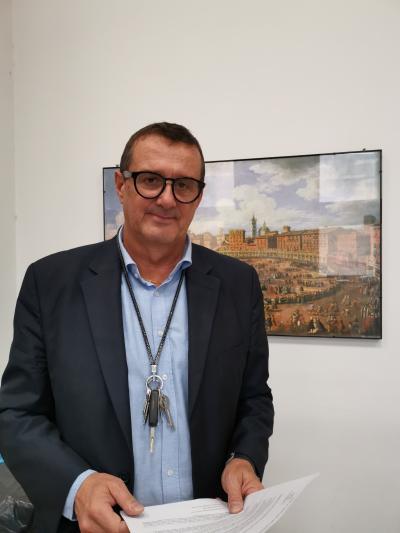
Gerardo Nicolosi
(Head of Department)